
Walking Tour – page 2
 Carry on until you reach a long low white-painted house on the right, which is:
 Point 2 Bagnio House. Originally dating from 1511 when it was the bath house and pleasure garden belonging to the Lord of Mann, the present building was converted by the Lord into a residence in 1692.
Opposite Bagnio House is the Wesleyan Methodist Chapel (since 1972 the only Methodist chapel in the town). The hall on the left was the original chapel, the present edifice having been built in 1833. John Wesley preached twice in Castletown, in 1777 and 1781.
Adjacent to the chapel you will see 31 Arbory Street with a façade of Ruabon brick brought back from Wales in the late 19th century as ballast in ships which had exported Manx lime; note especially the finial to the dormer window.
Bagnio House marked the end of the old town of Castletown. The original town had been clustered between the castle and the sea, but in the 16th century Arbory Street and Malew Street developed as suburbs. From about 1830 onwards, further land, beyond Bagnio House, began to be developed.
The large building on the right with the portico (unfortunately now lacking its pediment) is today the Castletown Youth Centre but was originally the Town Hall. The Manx poet T E Brown made his last public appearance there in 1897.
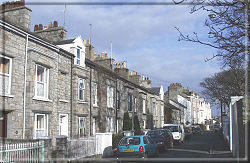
Carry on along Arbory Street and then take the first turn right. This road is the Crofts, now one of the smartest addresses in the town. It was laid out in the 1830’s and many of the buildings were designed by Thomas Brine. Originally almost all were rendered, and it is only in recent years that the stucco has been removed to expose the limestone, to mixed reactions. Note especially the three large houses on the right, Elderbank (a very distinctive design just visible behind a wall and black gate); Westwood and Crofton: the last of these was the residence of Dr John Clague, the town’s doctor at the turn of the century who wrote fascinating reminiscences.
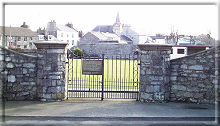
 At Point 3, half way along the Crofts, turn right into the bowling green, with Cookies Kitchen Café inside on the left.
Then go past the tennis courts and down to:
 Point 4 on Malew Street, (if the bowling green is closed, carry on to the end of the Crofts and turn right into Malew Street to pass the entrance to the tennis courts on your right).
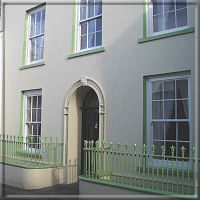 Facing you is the very fine cream and green Georgian facade of 48 Malew Street. The area to your left used to be one of the poorer areas of the town. In the 19th century many of the householders kept cows in their back yards. They would lead them out every morning through their houses and take them to graze in meadows beyond the town boundary before bringing them back again each evening.
Turn right along Malew Street, passing on your left the former Primitive Methodist Chapel now converted into offices. It has a very different appearance from the Wesleyan Chapel in Arbory Street built at ground level. The Primitive Chapel like most of its kind, was designed with a hall at ground level and steps leading to the chapel above.

