
Walking tour – page 3
 Point 5, the Old Bakery Café. The building dates from 1714 and has a fine porch composed of three very large slabs of granite. Note the plaque above the door.
Continue along Malew Street and through the principal shopping area of the town. Note many more fine shopfronts, notably number 17 (opposite the entrance to Bank Street) which was for many years a barber’s shop and beyond it the Victorian brickwork of H & E Cubbon’s fish shop.
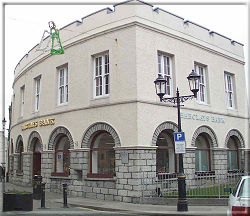 Ahead is the Market Square. On your left you will see Barclays Bank which was built as assembly rooms for the town, with a cool butter market underneath; the arches were originally open.
The wide stone slabs here are called the fish slabs as this was where the fish market took place. Note the war memorial and the early sundial which can tell the time in various different parts of the world. It is of a pattern more common in Scotland than in England.
 The grassy bank outside the Castle is the glacis. It was introduced as an outer defence against cannon; very few have survived elsewhere.
Now go through the iron gates to:
 Point 6, which is the Speaker’s Garden, an attractive oasis in the heart of the town.
(If the Speaker’s Garden is closed, retrace your steps along Malew Street and take the first turning on the right, Bank Street. At the end turn right along the Castle Quay.)
From the Speaker’s Garden follow the path anticlockwise around the Round Tower (originally part of the outer defences of the castle) onto the Castle Quay at:
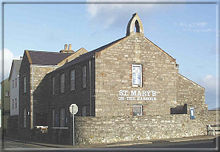

To your left, opposite the Chablis Cellar Restaurant, is St Mary’s on the Harbour, built in 1838 as the National School and later used as the Church Rooms; after the old St Mary’s Church on the Parade was condemned as unsafe, it was converted for worship.
On the other side of the harbour, behind the Irish Quay, note the two new houses recently built of local limestone, encouraging examples of new buildings in sympathy with their setting.
Behind them, in the trees, is Lorne House, first built in 1727 but much altered since. Between 1834 and 1860 it was the residence of the Island’s Lieutenant Governor. It is now offices and flats.
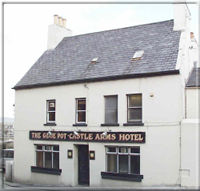 On your right is the Castle Arms Hotel, always known as the Glue Pot, one of the oldest public houses on the island.
Cross the road and walk between the harbour and the Glue Pot. The wall on your right was originally part of the outer defences of the castle.
The large slate-hung house across the harbour is Bridge House, for many years the residence of the Quayle family who held the post of Clerk of the Rolls (one of the judges of the Manx Courts) continuously from 1736 to 1879.
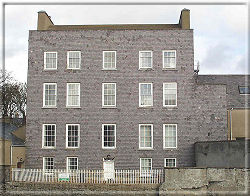 The story is told that later members of the family declined on principle to be connected to the town’s sewerage system, something which became only too apparent when a large number of troops were billeted in the house during the last war.
Bridge House itself is now an office but some of its outbuildings have been converted to house the Nautical Museum which is well worth a visit.

