
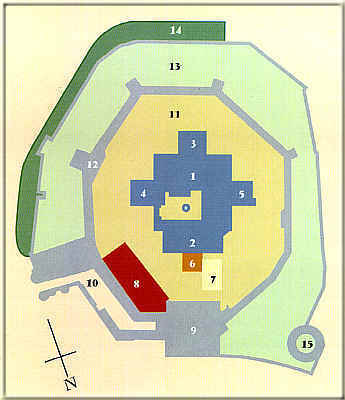
Entering Ancient Capital of Isle of Man. Castle Town Isle of Man can only be reached over the bridge and through the formidable Inner Gatehouse entrance in capital of isle of man. In the past, unwanted visitors could not simply walk over a fixed bridge. There was only a drawbridge pivoting against the wall with a drop below, and beyond this two portcullis with a “killing ground” between.
 The three “murder holes” in the vaulted ceiling are a reminder of the likely fate of any intruder unlucky enough to be trapped there – at the full mercy of defenders in the room above.
The Garrison Roll of 1428 indicates that there were 25 officials and household officers and 73 garrison soldiers at Peel Castle and Castle Rushen. By 1593 there were 55 soldiers at Castle Rushen alone who manned the day and night watches.
 Bishop Wilson’s Cell. The ground floor guardrooms on either side of the gatehouse entrance were in later times used as prison cells. None was used in 1722 to imprison the Island’s Bishop Wilson who had been found guilty of contempt of a State Court.
The Guardrooms. The guards on duty are wearing the badge of the Lords of Mann on their livery jackets. Each guardroom contains a vaulted cellar, possibly used as an “oubliette” for the detention of troublesome prisoners.
We overhear the ill-treatment and confinement of William Fisher by John Cote. Fisher died as a result and Cote was later executed for his cruelty. An inquiry into the incident is reported in the Garrison Roll.
 The Garrison Captain’s Lodgings. The gatehouses were the workplace of the garrison who manned the Castle. Many of the soldiers came from Lancashire and Cheshire, but a few were Manx. They had their own living quarters in the town and only spent their time on duty in the Castle, but officials such as the Captain of the Guard had their lodgings in some of the sparsely furnished upper rooms of the Inner Gatehouse – each main living area was en-suite with its own “garderobe” or toilet.
 The Portcullis Chamber. Through the “murder holes” which pierce the floor, certain death by a variety of unpleasant means could be dealt any attackers trapped in the “killing ground” between the two portcullises below. A spiral staircase, the only means of access all the way from ground level, leads to the fighting platform at the top of the Inner Gatehouse, where the view shows all of the southern parts of the Island, as far as the ridge of hills stretching from south-west to north-east.
Derbyhaven, with its sheltered bay and landing place, lies within easy distance of the Castle. Castletown Bay, with its rocky coast and exposure to the prevailing winds, is a much more difficult haven to enter.
 The Castle Chapel. At the top of the South Tower is the medieval chapel which also houses the Castle clock mechanism. The outside clock face on the South Tower is a well known Castletown landmark.
The Chapel has a piscina or shallow stone bowl for holy water, and the stone ledges which supported the altar can still be seen in the side walls of the east window.
 Medieval Furniture. The importance of the Lord’s presence on the “banker” or bench seat at the table is indicated by the cloth and canopy of the state which is raised above the fireplace. Most medieval tables consisted of solid planks resting on trestles which enabled quick removal after the meal to make room for entertainment or for the retainers to sleep.
The pieces of replica medieval furniture on display have been carefully researched to give an accurate impression of what would have been familiar to Thomas, last King of Mann, at the time of his visit to the Island in 1507.
Leave a Reply