
Old Grammar School
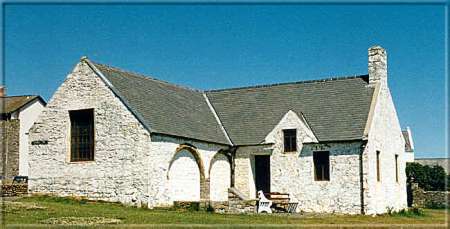
The Grammar School was originally a chapel built about 1190 – 1230 AD. It consisted of a nave and a south aisle divided by an arcade of three Romanesque arches. The arches were constructed of yellowish sandstone and supported by limestone piers. The doorway in the north wall may be original, but there are no surviving traces of the medieval windows, wall plaster, floor or roof materials.
 The school is sited on Castletown harbor with Castle Rushen to the north and the sea to the south. From the school, you can see out to Langness and Scarlett. The building stopped being used as a school in the 1930s and is now a museum to the public. It still has the original school desks, chairs, blackboards, etc. from the last days of the school.
17th century
In 1701 the town church ceased to be a church anymore and became a school instead. Because the church was not large enough to become a school they had to make some building changes. The south aisle was demolished, the two western arches blocked and an annex wing erected running toward the sea from the east end of the nave.
In 1757 Thomas Castley was appointed the master and held the post for 50 years He had an eventful term of office. The trustees attempted to reduce his salary as a master of the Free Grammar School from £60 to £30, but he took chancery proceedings and won his case.
In 1763 a committee of the House of Keys investigated a complaint that he had reduced the number of boys from 40 – 50 to 5-6 by demanding excessive fees and decided that Castley was, by deposition and practice, both a harsh and cruel man and was no longer allowed to be a teacher.
18th century
In 1829 a major restoration scheme was carried out and probably included minor structural alterations such as the conversion of one of the annex windows into a doorway leading to a schoolyard. Throughout the 18th century, most of the Island’s prominent men received their education at the school.
In 1886 Mr. Gilbert Holt was appointed to teach both the Free Grammar School and the Academic scholars. He received a salary for both positions. £30 from the Impropriety Fund and £30 from the Academic Master’s Fund plus fees paid by some of the scholars for their tuition. This was a princely total compared to the £5 paid to the master of the petty school. School life was strict, and students were always expected to look their very best.
Children had to wear clean clothes and have immaculately clean faces, hands, and fingernails. The teachers wore gowns and mortar boards. Students were given the cane if they misbehaved, and they were kept after school hours to write out lines.
One boy, when writing about his school life at the Grammar School, wrote that sometimes the teacher wouldn’t turn up after the time they had to write their lines to unlock the door. He said that he and his friends used to have to climb out of a window to get out.
The Grammar School:
is open daily from 10.00am until 5.00pm,
Saturday 1st April, to Tuesday 31st October 2000