
Walking Tour – page 1
Start at Point 1, in the Market Square outside the George Hotel.
Opposite the hotel is Castle Rushen, dating from the 12th Century and one of the best preserved castles in the country, largely through its use as the seat of government until the middle of the last century and later as a gaol; it was restored by the architect Armitage Rigby at the turn of the century. If you look up at the castle, you will see the clock, which it is claimed was presented by Queen Elizabeth I. It is a rare survival of an early type of one-handed clock.
The castle still contains a Law Court and a Registry Office, and the Island’s Governors are still sworn in there, a remarkable continuity as the seat of government for some eight hundred years.
Castle Rushen is now owned by the Manx Museum and National Trust and is open to visitors during the summer season. Allow at least an hour, and possibly more, for a visit.
The George Hotel has always been the principal hotel of the town. The building is in fact late Georgian although now masked by a Victorian facade.
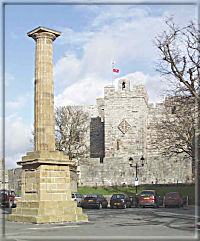 If you stand with your back to the hotel once more, you will see in front of you a column, the Smelt Monument, erected by public subscription in memory of Colonel Cornelius Smelt, a popular Lieutenant Governor who died in 1832. The story is told that there was a plan to put a statue on top but that the money ran out. It has recently been restored.
The Smelt Monument divides the Market Square on your left, where markets are still held in the summer, from the Parade on your right. The Parade is so called because the castle garrison used to parade there.
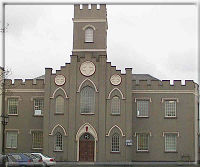 The former St Mary’s Church at the far end was built in 1822 to the designs of the prominent local architect Thomas Brine. To the great regret of many people in the town it was in 1977 declared by the church authorities to be unsafe and its box pews and marble monuments destroyed to make way for an office conversion. The tower was originally topped by an octagonal lantern giving it a more ecclesiastical appearance. Throughout the 19th century the Island’s Bishops were enthroned here as the cathedral on St Patrick’s Isle was in ruins.
 Walk round the Parade and look at the fine Georgian houses as you pass. The tallest house on the right hand side is Balcony House, once the residence of Captain Quilliam, who served on H. M. S. Victory at Trafalgar. This side of it, note also the red sandstone steps and gutters of 7 The Parade (next to the Co-op) and the fine doorcase and fanlight of the house at the far end, 5 The Parade.
Return back past the George, heading towards the attractive semi-circular building, also believed to be by Thomas Brine, which separates the two main shopping streets, Arbory Street and Malew Street. Before you come to this, note the large building on your left, now called Mannanan House, originally built as barracks for the soldiers garrisoning the castle, and for a time used as a town hall before being altered and converted into offices.
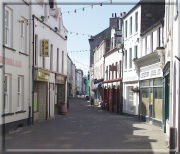 Beyond it is the Union Hotel where the writer George Borrow stayed in 1855. Note the canopy above the main door and also the white-painted building behind which may well be of mediaeval origin.
Proceed along Arbory Street, so called because it leads to the church of the neighbouring parish of that name. Notice, as throughout Castletown, the many fine shopfronts.

